Introducing bronto-community: A Place for Projects to Grow
Severin Neumann
Head of Community
Open source runs on remixing. You find a project that nearly does what you need, you fork it, you reshape it, and you push the useful parts back. That's how I've worked for years, and I still think it's the best deal in software.
Running an open source program office at Cisco, and then a long stretch working on OpenTelemetry, is where I came to appreciate that this goes well beyond code. How you license something, how you decide what's worth publishing, how a project grows up or moves on: people have been working on those questions in the open for a long time and writing down what they learned. You can remix that too.
So at Bronto when we set up a home for the things we build alongside the supported product, we took the well-trodden route. Our supported integrations and tooling stay in the official brontoio GitHub organization. bronto-community is where everything else grows: community maintained, and free to move fast, break things or be gloriously unfinished.
Plenty of companies run a second org like that, and the thinking underneath it isn't ours either. Open Source Archetypes, from Mozilla and Open Tech Strategies, sets out ten different shapes an open source project can take and points out that most projects fit several of them and change as they go.
The CNCF ladder of sandbox, incubation, graduated and archived, works because the entry stage is honest about being an entry stage. The TODO Group guides treat keep-it-or-donate-it as a decision you make deliberately rather than back into. At our size that's a way of thinking rather than a process, but it's the thinking we are starting from.
What's in bronto-community today
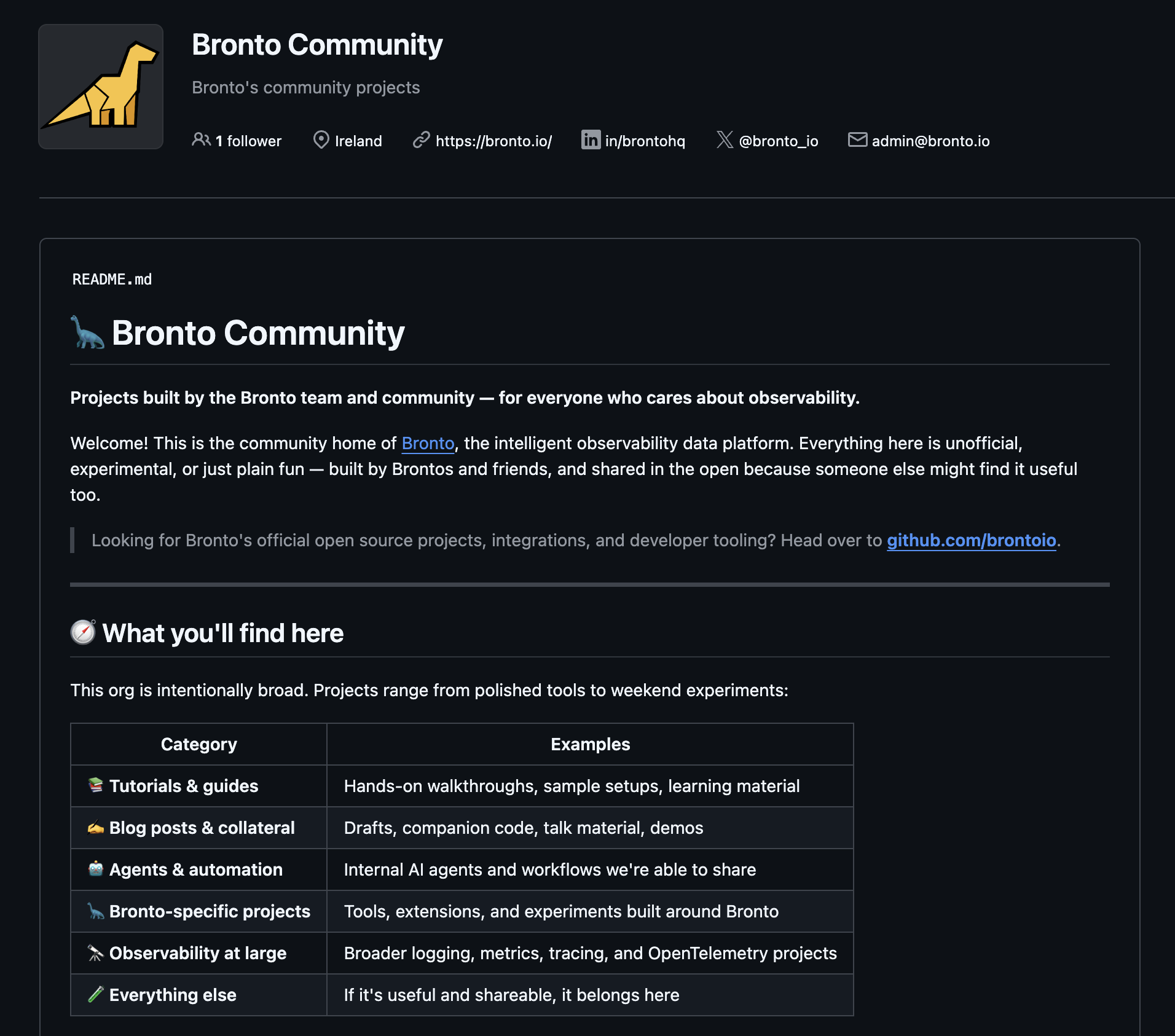
events-helper watches conference CFPs, matches them against what we actually want to talk about, files the promising ones into Jira and posts digests into Slack. It started as an internal tool and there was no good reason to keep it internal. Here's how it was built.
The AWS observability bill audit takes a CloudWatch bill apart and shows you what you're actually paying for. It does also project what the same data would cost on Bronto, but the first number it hands you is your own, and that one is worth having whether or not you ever talk to us.
v0-BrontoVibe is a Next.js log explorer you can fork and reshape into whatever view you actually want. There's a separate post on building your own UI on top of the Bronto API.
The slides from the talk I gave at the CNCF meetup in Karlsruhe at the end of July, on moving reliability work from manual to autopilot. Not code at all, which is rather the point.
There's a CLI for Bronto in there too, with a Homebrew tap, and that one gets its own post shortly. More is coming after it, some of it Bronto-specific and some of it useful well beyond Bronto, and I'm looking forward to showing those off as they land.
Where things go next
Projects in there are expected to move, and there's more than one direction they can move in.
Some will graduate to brontoio, once something has proven itself, people depend on it, and we're ready to support it properly.
Some should get donated, because a few things are more useful to more people when they don't live in a vendor's org at all, whether that means upstreaming into an existing project or handing it to a foundation.
I've spent enough time in OpenTelemetry to have strong feelings here: if a project's natural home is somewhere neutral then it should go there, and the fact that it started with us shouldn't hold it hostage.
Some will move out on their own, with their own org, their own maintainers and their own identity. Spinnaker started inside Netflix and now lives in its own org with maintainers from several companies.
And some will stay exactly where they are. Slides from a talk, companion code for a blog post, an experiment that answered its question and is finished at the size it is. Those were the right size all along.
Come build
Clone something and break it. Run the AWS audit against your own bill and see whether the number is as bad as you suspect. When something falls over, and something will, open an issue. Bug reports from the first few people to try a thing are worth more than stars.
And if you're building something in this space, whether it touches Bronto or not, come and tell me about it. A year from now I'd like to be linking to your repo.

Try Bronto free for 14 days
Centralize your agent and infrastructure telemetry in one platform with sub-second search and 12-month hot retention. No credit card required.